
Unique Traditions from Every Indian State: A Fascinating Journey Through India’s Cultural Diversity
India isn’t just a country—it’s a collection of countless stories, customs, and traditions that have evolved over thousands of years.
Travel a few hundred kilometers in any direction, and you’ll notice changes in language, food, clothing, festivals, and even daily routines. That’s what makes exploring India so fascinating. Every state has its own identity, shaped by history, geography, faith, and community life.
For travelers, entrepreneurs, and culture enthusiasts, understanding these traditions offers a deeper connection to the places they visit.
In this guide, we’ll explore some of the most unique traditions from every Indian state, showcasing the incredible cultural diversity that makes India unlike anywhere else in the world.
Why India’s Cultural Diversity Is Truly Unique
Few countries can match India’s cultural richness.
Across 28 states and 8 union territories, you’ll find:
- Hundreds of languages and dialects
- Diverse religious practices
- Unique festivals and rituals
- Distinct art forms
- Traditional lifestyles that continue today
These local customs and traditions in India aren’t just historical relics. They’re living practices passed down through generations.
Unique Traditions from Every Indian State
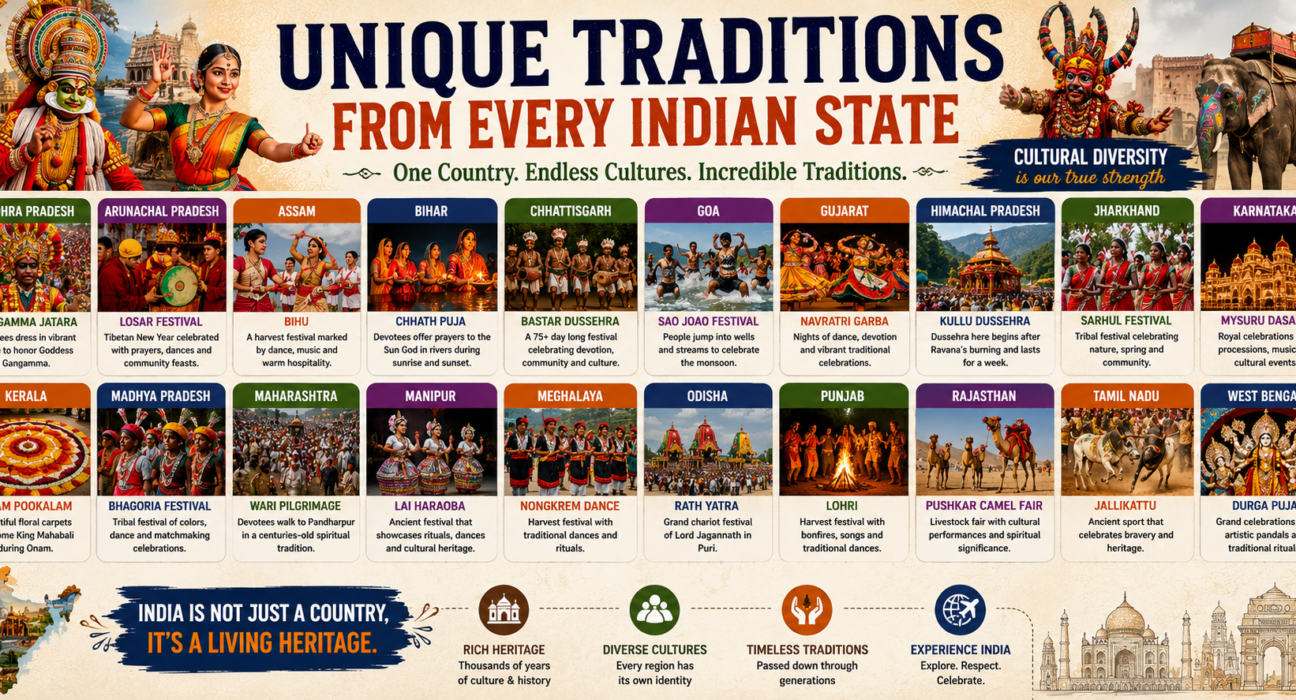
Andhra Pradesh – Gangamma Jatara
One of the most interesting traditions from different states of India, Gangamma Jatara is celebrated in Tirupati.
What Makes It Unique?
Participants wear elaborate disguises and costumes while honoring the goddess Gangamma.
The celebration blends devotion, folklore, and community participation.
Arunachal Pradesh – Losar Festival Traditions
Losar marks the Tibetan New Year and is celebrated with prayer ceremonies, traditional dances, and community gatherings.
Traveler Tip
Visit local monasteries to experience authentic cultural celebrations.
Assam – Bihu Hospitality Tradition
Bihu is more than a festival.
Families welcome guests with traditional food, music, and dance, reflecting Assam’s strong community culture.
Bihar – Chhath Puja
Perhaps one of India’s most unique rituals and traditions.
Devotees offer prayers to the Sun God while standing in rivers and water bodies during sunrise and sunset.
Why It’s Special
The festival emphasizes gratitude toward nature.
Chhattisgarh – Bastar Dussehra
Unlike the Dussehra celebrated elsewhere in India, Bastar Dussehra lasts over 75 days.
Interesting Fact
It’s one of the longest festivals in the world.
Goa – Sao Joao Festival
Young men jump into wells, ponds, and streams during this monsoon celebration.
Cultural Meaning
The festival honors St. John the Baptist and celebrates the arrival of the rains.
Gujarat – Navratri Garba
Garba is more than dance—it’s a cultural identity.
Entire communities gather for nights of traditional music and celebration.
Haryana – Traditional Haryanvi Akharas
Wrestling remains deeply embedded in rural culture.
Many villages continue to support traditional wrestling schools.
Himachal Pradesh – Kullu Dussehra
Unlike most places where Dussehra ends with Ravana’s effigy burning, Kullu Dussehra begins afterward.
Why Visit?
You’ll witness hundreds of local deities carried in grand processions.
Jharkhand – Sarhul Festival
The tribal communities celebrate nature and the arrival of spring.
Trees and forests hold special spiritual significance.
Karnataka – Mysuru Dasara
A royal tradition dating back centuries.
Highlights
- Decorated elephants
- Cultural performances
- Illuminated palaces
Kerala – Onam Pookalam Tradition
Families create intricate floral carpets called Pookalams outside their homes.
Community Spirit
Entire neighborhoods often participate together.
Madhya Pradesh – Bhagoria Festival
Known as a tribal festival of celebration and matchmaking.
Cultural Importance
It reflects centuries-old tribal traditions.
Maharashtra – Wari Pilgrimage
Lakhs of devotees walk hundreds of kilometers to Pandharpur.
Remarkable Feature
The pilgrimage has continued for over 700 years.
Manipur – Lai Haraoba
This ancient ritual festival celebrates the creation stories of the Meitei community.
Traditional dances play a central role.
Meghalaya – Nongkrem Dance Festival
A harvest festival showcasing Khasi traditions.
What You’ll See
- Traditional attire
- Ritual dances
- Community gatherings
Mizoram – Chapchar Kut
One of Mizoram’s biggest cultural celebrations.
Music, dance, and traditional sports dominate the festivities.
Nagaland – Hornbill Festival
Often called the “Festival of Festivals.”
Why Travelers Love It
Multiple tribal traditions are showcased in one event.
Odisha – Rath Yatra
Massive chariots carrying deities move through the streets.
Global Recognition
Millions of devotees participate every year.
Punjab – Lohri Celebrations
Bonfires, folk songs, and traditional dances mark the harvest season.
Rajasthan – Pushkar Camel Fair
A fascinating blend of livestock trading, cultural performances, and religious activities.
A Photographer’s Paradise
The vibrant atmosphere attracts visitors from around the world.
Sikkim – Pang Lhabsol
A unique festival celebrating Mount Kanchenjunga as a guardian deity.
Tamil Nadu – Jallikattu
One of India’s oldest traditional sports.
Historical Roots
The practice dates back more than 2,000 years.
Telangana – Bathukamma Festival
Women create beautiful floral arrangements and celebrate local traditions through music and dance.
Tripura – Kharchi Puja
An important ritual honoring fourteen deities.
The festival reflects the state’s royal heritage.
Uttar Pradesh – Lathmar Holi
In Barsana, women playfully chase men with sticks during Holi celebrations.
Cultural Symbolism
The tradition is linked to stories of Radha and Krishna.
Uttarakhand – Nanda Devi Raj Jat
Known as the “Himalayan Kumbh.”
This pilgrimage occurs only once every 12 years.
West Bengal – Durga Puja Art Installations
Each year, communities create elaborate artistic pandals that often reflect social themes.
More Than Religion
It’s one of the world’s largest public art celebrations.
What About India’s Union Territories?
Several union territories also preserve unique cultural traditions:
Ladakh
Masked monastery dances.
Jammu & Kashmir
Traditional Kashmiri weddings and Sufi traditions.
Puducherry
French-Indian cultural influences.
Andaman & Nicobar Islands
Indigenous tribal customs and island traditions.
Chandigarh
A blend of Punjabi and modern urban culture.
Why Understanding Local Traditions Enhances Travel
Many travelers visit destinations without learning about local customs.
As a result, they often miss the deeper cultural experiences that make travel memorable.
Understanding state-wise traditions in India helps travelers:
- Respect local communities
- Participate appropriately
- Build meaningful connections
- Discover authentic experiences
Common Mistakes Travelers Make
As a travel agency, we often see visitors make these mistakes:
Visiting During the Wrong Season
Many traditions and festivals occur only during specific times of the year.
Ignoring Local Etiquette
Simple cultural misunderstandings can affect the travel experience.
Focusing Only on Tourist Attractions
Often, local festivals and customs become the most memorable part of a trip.
How Our Travel Experts Help Cultural Travelers
Exploring cultural traditions requires more planning than many people realize.
Our specialists help travelers:
- Align trips with local festivals
- Arrange cultural experiences
- Connect with local guides
- Create customized itineraries
This allows visitors to experience India beyond the typical tourist circuit.
Real-World Example
A small business owner from Mumbai wanted to understand India’s cultural diversity while planning a family trip.
Instead of focusing solely on famous landmarks, we designed an itinerary around local festivals, artisan communities, and cultural events in Rajasthan and Gujarat.
The family later described the experience as “far more memorable than any sightseeing tour.”
Sometimes, culture creates stronger memories than monuments.
Why Cultural Tourism Is Growing in India
Modern travelers increasingly seek experiences rather than checklists.
They want:
- Authentic local interactions
- Traditional food experiences
- Festival participation
- Cultural storytelling
India’s incredible diversity makes it one of the world’s best destinations for cultural tourism.
Frequently Asked Questions
What are the most unique traditions from every Indian state?
Examples include Chhath Puja in Bihar, Kullu Dussehra in Himachal Pradesh, Bathukamma in Telangana, and Jallikattu in Tamil Nadu.
Which Indian state has the most unique cultural traditions?
Every state offers distinct traditions, but Rajasthan, Nagaland, Kerala, Gujarat, and West Bengal are particularly known for their cultural richness.
What are some famous traditions of each state in India?
Popular traditions include Garba in Gujarat, Onam in Kerala, Durga Puja in West Bengal, and Rath Yatra in Odisha.
Why are traditional customs important in Indian states?
They preserve cultural identity, strengthen communities, and connect people to their heritage.
How can travelers experience local customs and traditions in India?
The best way is to visit during local festivals, work with experienced guides, and participate respectfully in community events.
Final Thoughts
India’s diversity isn’t something you simply observe—it’s something you experience.
From the floral celebrations of Telangana and Kerala to the tribal festivals of Nagaland and Jharkhand, every state offers traditions that tell a unique story.
For travelers, understanding these customs transforms a simple trip into a meaningful journey.
And in a country as diverse as India, there is always another tradition waiting to be discovered.
Contact us today for a free consultation.